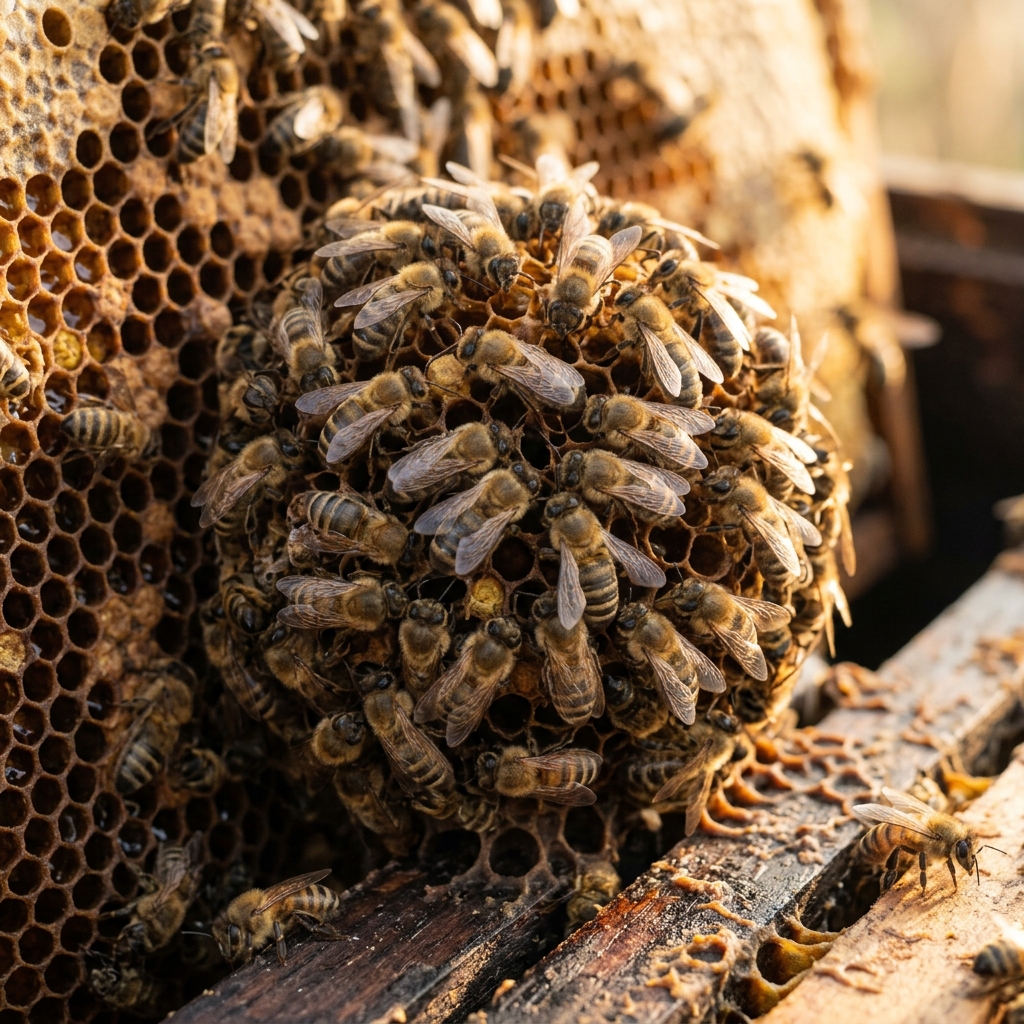
Seeing a tight cluster of bees around your queen is alarming, and the instinct is to assume the worst. But balling doesn't always mean what beekeepers think it means, and a popular shortcut for predicting it doesn't hold up well either.
This guide covers what balling actually indicates, a common myth about testing acceptance before introducing a queen, and why the causes are often harder to pin down than people expect.
Balling Isn't Always an Attack
The common assumption is that a tight cluster of bees around a queen means they're trying to kill her. Sometimes that's true. But bees also ball a queen to protect her, clustering tightly around her when they sense a threat, such as another queen nearby. From the outside, protective balling and hostile balling can look nearly identical, which makes it genuinely hard to know which one you're seeing in the moment.
The "Cage on Top Bars" Test Doesn't Really Work
A popular shortcut circulating on beekeeping forums claims you can predict acceptance without a full inspection. The idea is to place a caged queen on top of the frames, without opening the hive, and watch how the bees react. A queenright hive is supposed to ball the cage aggressively, while a queenless hive is supposed to act calm and welcoming.
Testing this side by side on a queenright hive and a queenless hive at the same time doesn't show a meaningful difference. Bees on both types of hives tend to cluster around the cage with similar intensity, likely just general curiosity about a new queen's scent rather than a real acceptance signal. A related shortcut, brushing bees off the cage and timing how fast they return, doesn't reveal much either. Both are appealing because they skip a real inspection, but neither one reliably predicts what will actually happen when you introduce her.
Why the Real Cause Is Often Hard to Know
Even after the fact, it's often difficult to say exactly why bees balled a particular queen. If a colony already has a supersedure cell underway and has effectively picked a favorite replacement, a queen introduced from outside that process may get balled simply because the colony has already committed to a different queen, not because anything is wrong with the one you brought.
Handling scent is sometimes blamed too, the idea being that touching a queen might transfer something that makes her smell wrong to her new colony. It's a reasonable-sounding theory, but it isn't well supported by direct evidence, and plenty of experienced beekeepers handle queens constantly without seeing a pattern of rejection tied to it.
What This Means for You
Skip the shortcuts and do the real inspection. If you find a colony already raising its own supersedure cells, that's a stronger signal about what they want than any cage-on-top-bars test will give you. And if a queen does get balled after introducing her with a frame cage, it's worth resisting the urge to assume you know exactly why. Sometimes there simply isn't a clean answer. I've handled plenty of queens over the years and still can't always tell you why one gets rejected and another doesn't.
Frequently Asked Questions
Does balling always mean the bees are trying to kill the queen?
No. Balling can also be protective, with bees clustering tightly around a queen in response to a perceived threat. The two can look very similar from the outside.
Does placing a caged queen on top of the frames predict how a hive will react?
Not reliably. Testing this side by side on queenright and queenless hives shows similar reactions in both cases, so it isn't a trustworthy shortcut for skipping a real inspection.
Why would bees ball a queen if the colony is already queenless?
If the colony has already started supersedure cells and effectively chosen its own replacement, an outside queen introduced around the same time may get rejected simply because the colony has already committed to a different one.
Can handling a queen with your hands cause her to be rejected?
It's a commonly repeated theory, but it isn't well supported by evidence. Many experienced beekeepers handle queens regularly without a consistent pattern of rejection tied to it.
What should I do if I find a colony has already started supersedure cells?
Treat that as real information about what the colony wants. Introducing a different queen from outside at that point carries a higher risk of rejection than letting the colony finish what it started.